CapstoneOne Open-BioAFE channel
Combine Lab 5, a PGA and Lab 8 (SAR) or Lab 10 (ΔΣ), and optionally Lab 15; verify across corners; feed real ECG and EEG through the transistor-level chain with ngspice PWL sources; and report against the specification of Table 1.2. The best designs go to an IHP OpenMPW submission.
A reference run. .venv/bin/python labs/spice/capstone_chain.py (five ngspice runs; Docker’s 7.75 GB allows about three long transients at a time) does a first version of the capstone with the Lab 5 front-end: SG13G2 transmission-gate choppers, a behavioural OTA and the 300 mV electrode offset. It runs that front-end at three MOS corners, then drives it with real recordings as ngspice PWL sources and passes its output through the PGA, decimation to 500 S/s and a 16-bit quantiser:
| Run | Result |
|---|---|
| Corners tt / ss / ff, 1 mV at 37 Hz | gain 91.7 / 91.7 / 91.8; output offset 2.7 / 2.9 / 2.4 mV; ripple 1.2 mV; input impedance 6.5 MΩ |
| MIT-BIH record 100, 3 s, PGA ×1 | chain gain 96, SNR 28.5 dB over 3–40 Hz (6.2 µVrms of error referred to the input); Lab 11’s detector finds 3 of 3 R peaks, no extra detections |
| CHB-MIT chb01_03, FP1-F7, 2 s from the seizure onset, PGA ×8 | chain gain 772, SNR 31.1 dB over 3–40 Hz (1.06 µVrms of error on a 37.8 µVrms signal) |
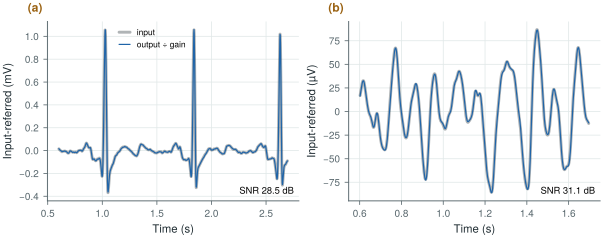
labs/spice/capstone_chain.py and figsrc/labs_figs.py.Figure LC.1 shows the two recordings. The comparison passes the input through the designed response first, the lab netlist’s 2 Hz servo high-pass (four times the chip’s 0.5 Hz, so that a few seconds of simulation settle), because at 3–8 Hz that high-pass alone shifts the phase by 10–30° and would otherwise read as error. What remains, a few microvolts, is chopper residue and the servo’s settling within a short record; a longer run, the transistor-level OTA of labs/spice/sg13_ota.py and the converter of Lab 8 or 10 are the next steps toward the full capstone.
All labs · Previous: Lab 15. Bioimpedance IQ readout