Open-BioAFE · IHP SG13G2 · 8-channel ExG front-end
Designing a Biopotential Acquisition Chip from Scratch
A design tutorial for undergraduate and early-graduate engineers building an open-source biomedical analog front-end and data converters in 130 nm SiGe BiCMOS. Bioelectric signals, electrodes and safety, low-noise amplifiers, chopping, SAR and ΔΣ ADCs, bioimpedance sensing, biosignal processing, the open-source flow, and hands-on labs.
Every wearable ECG patch, EEG headset, prosthetic-control armband and neural implant needs a chip that turns microvolt biopotentials into clean numbers while the body picks up volts of mains interference and the battery allows a few microwatts per channel. This tutorial follows one design, the Open-BioAFE front-end in IHP’s open SG13G2 PDK, from the signals and electrodes to a tape-out-ready architecture. Every concept follows the same pattern: a short derivation, a worked example with the project’s real numbers, and a what this means for your design box. The numbers above are the design targets (Table 1.2).
What is inside
Foundations
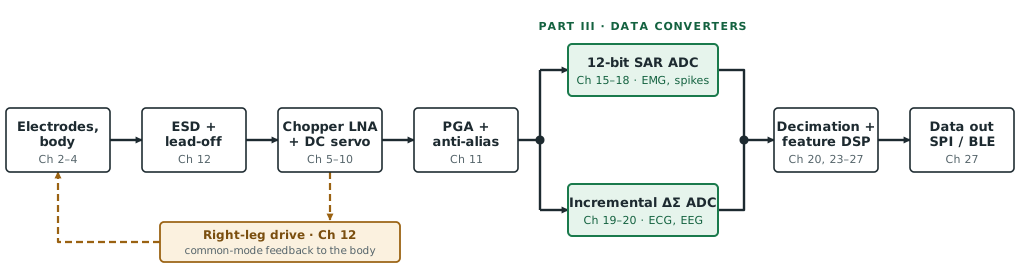
Why biomedical ICs, bioelectric signals, electrodes and the body as a circuit, interference, safety and standards.
The analog front-end
Devices in weak inversion, noise and power, instrumentation amplifiers, the AC-coupled LNA, chopping, DC servo loops, filters and common-mode control.
Data converters
Sampling, specifications, switches, comparators, capacitive DACs, the SAR ADC, ΔΣ theory and circuits, and ADC testing.
Biosignal processing and systems
DSP for biosignals, ECG, EEG and EMG processing on open datasets, on-chip features and bioimpedance sensing.
Putting it together
The full architecture and its budgets, and the open-source flow to an IHP OpenMPW tape-out.
Wearable systems
Signal quality and motion-artefact cancellation, ear-EEG and multimodal sensing at the ear, and closed-loop systems that act on what they measure.
Hands-on labs
Fifteen labs in three tracks with free tools: Python models, SG13G2 circuits, and the whole chain on real recordings, then a capstone that builds one Open-BioAFE channel.
Reference material
A formula sheet, reference tables, design-review checklists, a glossary and further reading.
Hands-on labs
Fifteen labs in three tracks use only free tools: Python for signal and system models, Xschem and ngspice for SG13G2 circuits, and KLayout for layout. They are listed on the Hands-On Labs page; the scripts live in labs/python/.
About
The tutorial is written for the Open-BioAFE project at BRICD (Biomedical Research in Integrated Circuit Design). It builds on IHP’s open SG13G2 PDK, JKU’s IIC-OSIC-TOOLS and open data from PhysioNet and NinaPro. Every source is listed on the References page.
How this tutorial is made. The Open-BioAFE Tutorial is being developed with the help of AI tools, and this draft may contain mistakes. If you spot one, please email bricd.org@gmail.com and we will correct it.
This is a living draft (v0.1, November 2026): all thirty-three chapters, the appendices and the fifteen hands-on labs are written, and most chapters have an interactive demo. Corrections and contributions are welcome through GitHub issues.