Preface
Every fast interface, from a PCIe slot to the backplane of an Ethernet switch, moves its data over a serial link: a transmitter, a lossy wire and a receiver that recovers both the bits and the clock. This book teaches you to design one by following a single, concrete chip, the Open-SERDES transceiver: a 5 Gb/s NRZ link built in the open-source IHP SG13G2 130 nm SiGe BiCMOS process [1] with open-source tools [2].
Who this book is for
Third- and fourth-year electrical engineering undergraduates who will help design the Open-SERDES chip, and anyone who wants a practical first course in high-speed links. After reading it you should be able to:
predict the eye a channel will produce from its loss and pulse response;
choose and size the TX FFE, CTLE and DFE for a channel, and defend the split;
turn a link budget into specifications for the driver, front end, samplers, PLL and CDR;
model the link in Python, then carry it through schematic, layout and sign-off with open tools.
Prerequisites
Basic circuits (KCL, small-signal MOS and BJT models, the differential pair), signals and systems (Fourier, Laplace, convolution) and some Python. Transmission lines, equalization, jitter, PLLs and CDRs are built up from first principles.
How the book is organized
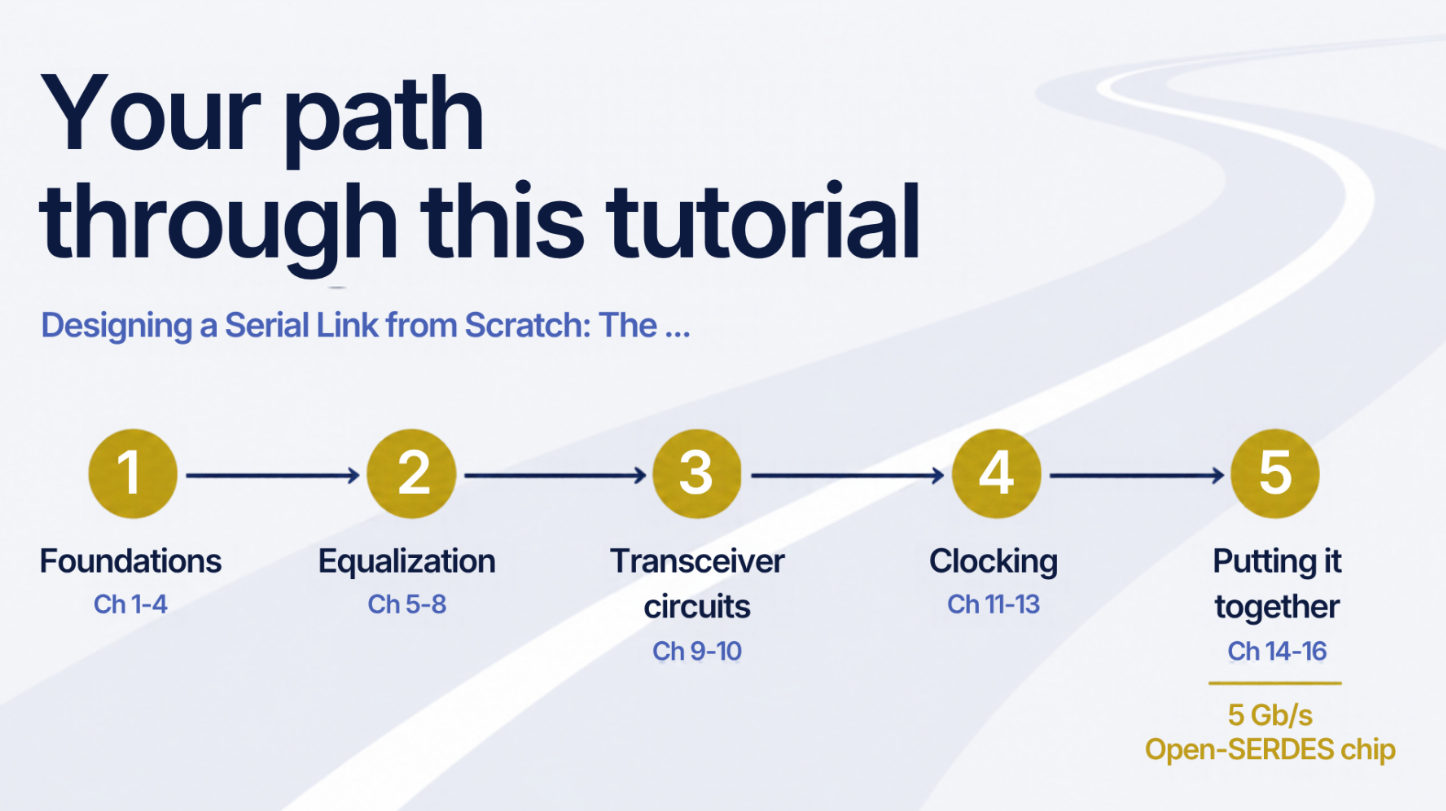
The book has five parts, shown in Figure 1. Part I, Foundations (Chapters 1–4), gives you the vocabulary of links (pulse response, eye diagram, bit-error rate), the physics of the channel and the tools for a link budget. Part II, Equalization (Chapters 5–8), shows how the TX FFE, the CTLE and the DFE undo the channel, and how to split the work between them. Part III, Transceiver Circuits (Chapters 9–10), turns the system model into HBT and CMOS circuits. Part IV, Clocking (Chapters 11–13), covers jitter, the PLL and clock and data recovery. Part V, Putting It Together (Chapters 14–16), assembles the full architecture, walks through the open-source design flow and collects the hands-on labs.
Two reading paths
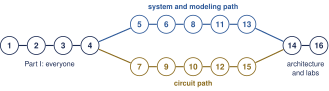
Everyone should read Part I first. After that, Figure 2 suggests two routes. The system and modeling path suits readers who will own the link budget and the serdespy model. The circuit path suits readers who will design transistors and layout. Both paths meet again at the architecture chapter and the labs.
How to read the boxes
Chapters open with what you will learn and close with key takeaways. In between, six kinds of boxes mark the role of each piece of text:
Key equation · Bit period
\[T_\mathrm{b}= \frac{1}{f_\mathrm{b}} = \frac{1}{5\,\mathrm{Gb}/\mathrm{s}} = 200\,\mathrm{ps}\]
Worked Example P.1 · A number you will use on every page
At 5 Gb/s, \(f_\mathrm{N}= f_\mathrm{b}/2 = 2.5\,\mathrm{GHz}\); channel loss is quoted there.
What this means for your design
An insight box says what a result means for the Open-SERDES design.
Common pitfall
A pitfall box warns about a common mistake, such as quoting loss at 5 GHz.
Lab 0: set-up
A try-it box points to a lab script (Section 16.1).
Open-SERDES target
A specnote box states an Open-SERDES target: 5 Gb/s NRZ at \(\mathrm{BER}\le 10^{-12}\).
Longer algebra sits in grey derivation boxes.
How the labs work
The labs of Chapter 16 reproduce the key plots of the book with serdespy [3], a Python library for system-level SerDes modeling, plus NumPy and SciPy. The scripts live in tutorial/code/ and share one file, common.py, that defines the link, the reference channel and the helpers; the figure scripts in tutorial/figsrc/ import the same model, so labs and figures use the same numbers. Run a lab, change a parameter and compare your plot with the text.
Sources and acknowledgments
The link-modeling chapters follow the structure of Prof. Sam Palermo’s ECEN 720 High-Speed Links course at Texas A&M University [4]. The labs are built on serdespy by Richard Barrie and colleagues at the University of Toronto [3]. The chip itself is possible because IHP opened its SG13G2 process design kit [1] and the Institute for Integrated Circuits at JKU Linz maintains the IIC-OSIC-TOOLS container and the analog chip template [2, 5].
This is a living draft (v0.1); numbers will be refined as the design matures. If you find an error, an unclear derivation or a figure that does not explain what it should, please email bricd.org@gmail.com or open an issue or a pull request on the project’s GitHub repository, linked from thebricd.org.
How this book was made
This book, its figures and lab code, and the accompanying slides were developed with the help of AI tools. The authors reviewed the text, figures and code, but errors may remain; please report any you find as described above, and we will correct them. The topics, structure and many of the results follow the sources acknowledged above and listed in the References.
Generated from book/tutorial/chapters/00_preface.tex. Figure, table and equation numbers match the PDF edition.