Open-SERDES · IHP SG13G2 · 5 Gb/s NRZ
Designing a Serial Link from Scratch
A design tutorial for undergraduate engineers building an open-source high-speed SerDes in 130 nm SiGe BiCMOS. Channels, link budgets, equalization, transmitter and receiver circuits, jitter, PLLs and clock recovery, the open-source design flow, and hands-on labs.
Every fast interface (PCIe, USB, Ethernet, chiplet links) rides on a SerDes, yet SerDes design is rarely taught end to end and almost never in the open. This tutorial follows one design, the Open-SERDES transceiver in IHP’s open SG13G2 PDK, from the physics of the channel to a tape-out-ready architecture. Every concept follows the same pattern: a short derivation, a worked example with the project’s real numbers, and a what this means for your design box.
What is inside
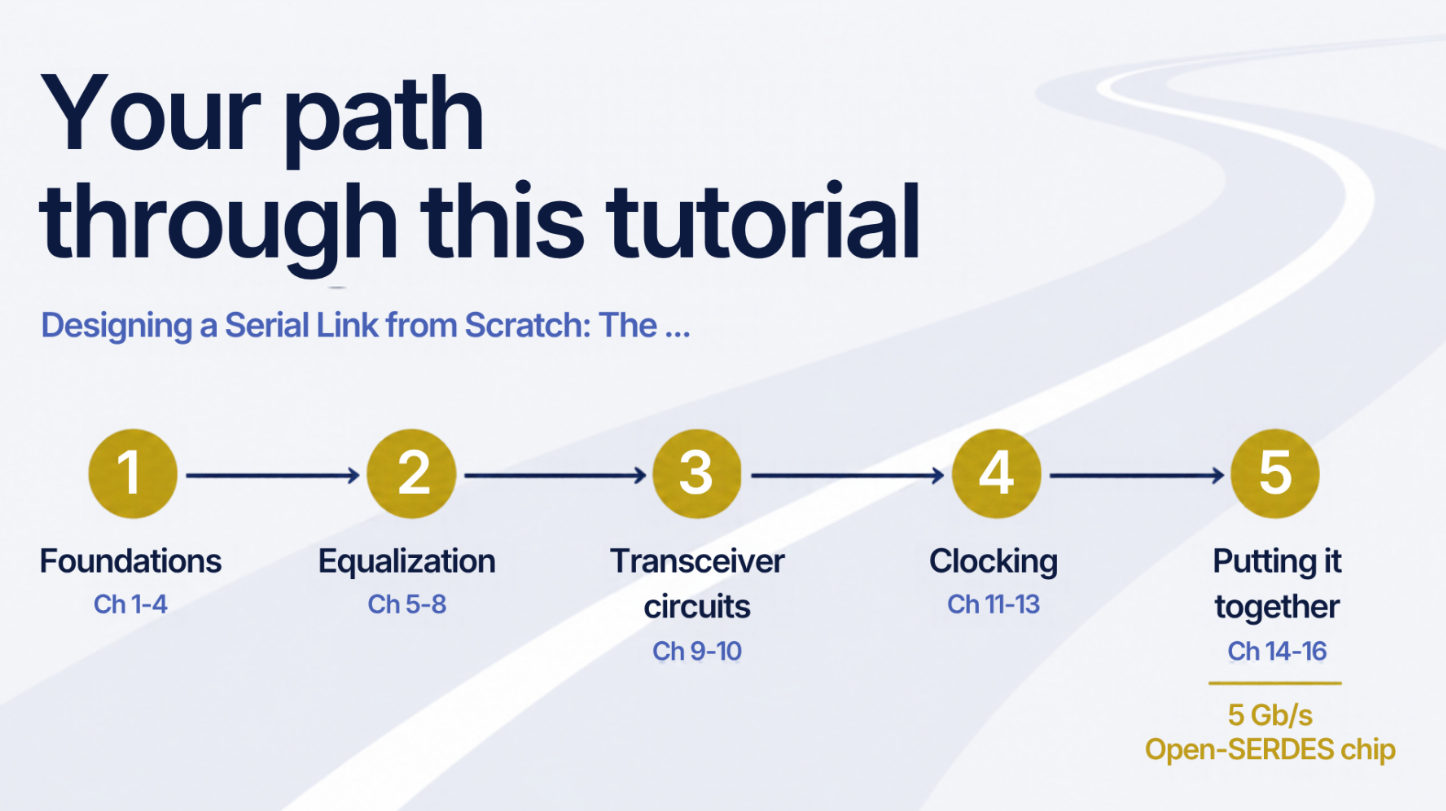
Foundations
Serial links, NRZ and PRBS, pulse responses and eyes, the channel, PDA and statistical link budgets.
Equalization
TX FFE, CTLE and DFE theory and circuits, adaptation, and how to split the work between them.
Transceiver circuits
Serializer, CML driver, termination and ESD; receiver front-end, StrongARM and HBT latches, metastability.
Clocking
Jitter and the dual-Dirac model, the charge-pump PLL and LC VCO, and a phase-interpolator CDR.
Putting it together
The full architecture and budgets, the open-source design and verification flow, and seven serdespy labs.
Reference
Formula sheet, Q-function and dB tables, design-review checklists, glossary and further reading.
Hands-on labs
Chapter 16 reproduces the key plots of the book with serdespy: the reference channel, PRBS eyes, TX FFE, CTLE and DFE sweeps, jitter and BER, and a bang-bang phase-interpolator CDR. The scripts live in book/tutorial/code/.
About
The tutorial is written for the Open-SERDES project at BRICD (Biomedical Research in Integrated Circuit Design). It draws on Prof. Sam Palermo’s ECEN 720 course notes (Texas A&M), serdespy, IHP’s open PDK and JKU’s IIC-OSIC-TOOLS. Every source is listed on the References page.
How this tutorial was made. The Open-SERDES Tutorial was developed with the help of AI tools. The text, figures and code were reviewed by the authors, but errors may remain. The topics, structure and many of the results follow the sources listed in the References, especially Prof. Sam Palermo’s ECEN 720 course. If you spot a mistake, please email bricd.org@gmail.com and we will correct it.
This is a living draft (v0.1, October 2026). Corrections and contributions are also welcome through GitHub issues.