Chapter 6Transmit FFE
The transmitter knows every bit before it leaves the chip, so it can pre-distort the waveform to cancel the ISI the channel is about to add.
In this chapter you will learn
Describe the TX feed-forward equalizer (FFE) as a 3-tap FIR filter, and write its output and its effect on the pulse response.
Derive the FFE frequency response and the de-emphasis in dB, and explain the peak-swing constraint \(\sum\lvert c_k\rvert=1\).
Solve for zero-forcing taps as a small matrix equation, and say when least squares does better.
Show on the REF channel why zero-forcing taps are not eye-optimal (Lab 3).
Pick practical settings: standard presets, tap resolution, and the swing the FFE costs.
6.1A FIR filter in the driver
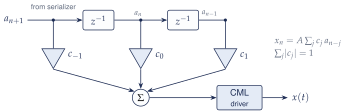
The TX FFE is a finite-impulse-response filter that acts on the symbol stream \(a_n\in\{-1,+1\}\) before the driver (Figure 6.1). With three taps, the driver output during UI \(n\) is \[x_n=A\left(c_{-1}\,a_{n+1}+c_0\,a_n+c_1\,a_{n-1}\right). \tag{6.1}\] The pre-tap \(c_{-1}\) weights the next bit. The transmitter already knows that bit, because in hardware the whole chain is delayed by one UI. The main tap is \(c_0\) and the post-tap is \(c_1\). The general \((2M+1)\)-tap version is \(H(z)=\sum_{k=0}^{2M}\alpha_{-M+k}z^{-k}\) with \(z=e^{j\omega T_\mathrm{b}}\). It has no feedback, so it is unconditionally stable.
Since the channel is linear, sending \(x_n\) is the same as sending three scaled, shifted copies of each bit. The pulse response seen at the receiver is therefore the convolution of the tap list with the cursor list: \[q_k=\sum_{j=-1}^{1}c_j\,p_{k-j}=c_{-1}p_{k+1}+c_0p_{k}+c_1p_{k-1}. \tag{6.2}\] Equation (6.2) is all we need. Every FFE question in this chapter is a question about the new cursors \(q_k\).
6.2De-emphasis, pre-emphasis and the swing limit
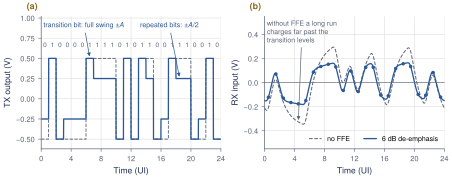
The driver’s output swing is fixed by its tail current and load at \(\pm A\). By Equation (6.1), the largest output occurs when all terms add, so it equals \(A\sum\lvert c_k\rvert\). To keep the driver within its swing we require the peak-power constraint: \[\lvert c_{-1}\rvert+\lvert c_0\rvert+\lvert c_1\rvert=1 . \tag{6.3}\] For a low-pass channel the side taps are negative. Consider a 2-tap FFE with \(c_1<0\). A transition bit (\(a_n=-a_{n-1}\)) gets \(\lvert x_n\rvert=A(c_0+\lvert c_1\rvert)=A\), the full swing. A repeated bit gets \(A(c_0-\lvert c_1\rvert)\), which is smaller. This is de-emphasis: transitions keep full swing and runs of identical bits are attenuated (Figure 6.2).
Pre-emphasis has exactly the same filter shape, but it is scaled the other way. It keeps \(c_0=1\) and lifts the transitions to \(A(1+\lvert c_1\rvert)\). A driver that already runs at its maximum swing has no headroom for that, so a practical TX de-emphasizes.
Frequency response
The FFE transfer function is \(H_\mathrm{FFE}(f)=\sum_k c_k\,e^{-j2\pi fkT_\mathrm{b}}\). For two taps, \(\lvert H\rvert^2=c_0^2+c_1^2+2c_0c_1\cos(2\pi fT_\mathrm{b})\). Normalized to \(c_0=1\), \(c_1=\alpha\), with \(-1<\alpha<0\):
Key equation · 2-tap FFE response and de-emphasis
\[\lvert H_\mathrm{FFE}(f)\rvert=\sqrt{1+\alpha^2+2\alpha\cos(2\pi fT_\mathrm{b})},\qquad \mathrm{DE}=20\log_{10}\frac{\lvert H(f_\mathrm{N})\rvert}{\lvert H(0)\rvert}=20\log_{10}\frac{1-\alpha}{1+\alpha} \tag{6.4}\] With \(\sum\lvert c\rvert=1\) the response is \(c_0+c_1=1-2\lvert c_1\rvert\) at DC and \(c_0-c_1=1\) at \(f_\mathrm{N}\), so \(\mathrm{DE}=-20\log_{10}(1-2\lvert c_1\rvert)\).
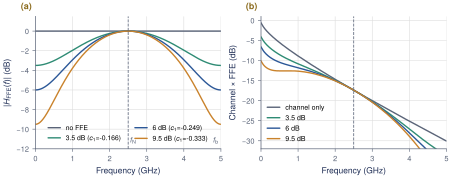
As a check, Equation (6.4) gives \(1+\alpha\) at DC and \(1-\alpha\) at \(f_\mathrm{N}\). The response rises monotonically from DC to \(f_\mathrm{N}\) and repeats with period \(1/T_\mathrm{b}=5\,\mathrm{GHz}\) (Figure 6.3a). It never rises above 0 dB. It only pulls the low frequencies down.
Worked Example 6.1 · The PCIe de-emphasis presets in volts
PCIe Gen2 at 5 GT/s specifies TX de-emphasis of −3.5 dB and −6 dB. For \(-3.5\) dB, \(1-2\lvert c_1\rvert=10^{-3.5/20}=0.668\), so \(c_1=-0.166\) and \(c_0=0.834\). For \(-6\) dB, \(1-2\lvert c_1\rvert=0.501\), so \(c_1=-0.249\) and \(c_0=0.751\).
With \(A=0.5\,\mathrm{V}\) (1 Vppd), transition bits swing \(\pm500\,\mathrm{mV}\) in both cases. Repeated bits swing \(\pm0.668\times500=\pm334\,\mathrm{mV}\) at \(-3.5\) dB and \(\pm251\,\mathrm{mV}\) at \(-6\) dB. A 9.5 dB setting would need \(c_1=-1/3\) and leave repeated bits at \(\pm167\,\mathrm{mV}\).
In a CML driver the taps steer a fixed total tail current, so the supply current is the same at every setting. De-emphasis does not save power. It only redistributes the swing.
6.3Solving for the taps
Zero forcing
Choose the three taps so that the equalized pulse has \(q_{-1}=0\), \(q_0=1\) and \(q_1=0\). Writing Equation (6.2) for \(k=-1,0,1\) gives three linear equations in three unknowns. Each row is one cursor of the equalized pulse, and each column is the pulse shifted by one tap:
Key equation · Zero-forcing FFE taps
\[\begin{bmatrix}p_{0}&p_{-1}&p_{-2}\\ p_{1}&p_{0}&p_{-1}\\ p_{2}&p_{1}&p_{0}\end{bmatrix} \begin{bmatrix}c_{-1}\\ c_0\\ c_1\end{bmatrix}= \begin{bmatrix}0\\1\\0\end{bmatrix}, \qquad c_k\leftarrow\frac{c_k}{\sum_j\lvert c_j\rvert}. \tag{6.5}\]
The matrix has constant diagonals: it is a Toeplitz matrix. A \((2M+1)\)-tap FFE gives a \((2M+1)\times(2M+1)\) system of the same form. The normalization step comes last. It scales the whole equalized pulse down, but it does not change where the zeros are.
Worked Example 6.2 · A 3-tap zero-forcing FFE
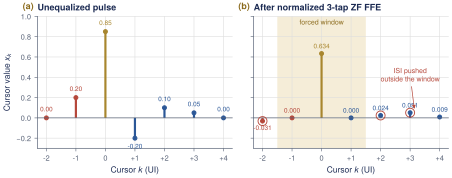
Take an example pulse with \(x_{-1}=0.2\), \(x_0=0.85\), \(x_1=-0.2\), \(x_2=0.1\) and \(x_3=0.05\). Equation (6.5) reads \[\begin{bmatrix}0.85&0.2&0\\-0.2&0.85&0.2\\0.1&-0.2&0.85\end{bmatrix} \begin{bmatrix}\alpha_{-1}\\\alpha_0\\\alpha_1\end{bmatrix}=\begin{bmatrix}0\\1\\0\end{bmatrix} \;\Rightarrow\;\boldsymbol\alpha=[-0.248,\ 1.053,\ 0.277].\] Since \(\sum\lvert\alpha\rvert=1.578\), the normalized taps are \([-0.157,\ 0.667,\ 0.176]\). The equalized cursors for \(k=-2..4\) are \([-0.031,\ 0,\ 0.634,\ 0,\ 0.024,\ 0.051,\ 0.009]\). With \(2A=1\), the PDA eye opens from \(0.85-0.55=0.30\) to \(0.634-0.115=0.519\) (Figure 6.4). Three lessons:
The post-tap is positive, because \(x_1\) is negative. ZF inverts whatever ISI is there. This FFE is not even high-pass: it is \(-3.3\) dB at DC and \(-3.8\) dB at \(f_\mathrm{N}\).
ISI is pushed outside the forced window. A new cursor appears at \(k=-2\), and \(k=3\) grows from 6 % to 8 % of the main cursor.
Normalization costs main cursor. It drops from 0.85 to 0.634.
Least squares and MMSE
Zero forcing looks at only \(2M+1\) cursors. Least squares (LS) uses the whole pulse. Stack shifted copies of the full pulse as the columns of a matrix \(\mathbf H\) (one row per output cursor), then minimize \(\lVert\mathbf H\mathbf c-\mathbf y_\mathrm{des}\rVert^2\), where \(\mathbf y_\mathrm{des}\) is 1 at the main cursor and 0 elsewhere. The solution is \(\mathbf c=(\mathbf H^\mathsf{T}\mathbf H)^{-1}\mathbf H^\mathsf{T}\mathbf y_\mathrm{des}\), which is then normalized. For a receiver FIR, where noise passes through the filter, the noise-aware MMSE form adds \((\sigma_\mathrm{n}^2/\sigma_a^2)\mathbf I\) to \(\mathbf H^\mathsf{T}\mathbf H\). Palermo’s 10 Gb/s example gives \(\mathbf c=[-0.131,\ 0.595,\ -0.274]\) [22]. Its DC gain is \(\sum c=0.190\) (\(-14.4\) dB) and its Nyquist gain is \(\lvert\sum(-1)^kc_k\rvert=1\), so it applies 14.4 dB of de-emphasis, all of it paid in swing.
The REF channel
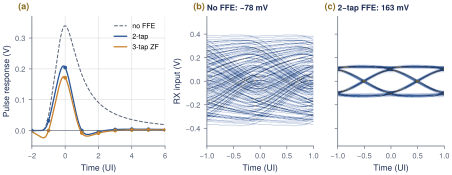
Lab 3 applies Equation (6.5) to the REF cursors \(p_{-1}=0.0486\), \(p_{0}=0.3396\) and \(p_{1}=0.1817\). The 3-tap ZF taps are \([-0.0853,\ 0.5959,\ -0.3188]\), which is 14.3 dB of boost. The 2-tap ZF taps, forcing only \(q_1=0\), are \([0.6515,\ -0.3485]\), or 10.4 dB. Figure 6.5 shows the result for PRBS7. The eye goes from −77.8 mV without FFE to 162.7 mV (0.89 UI) with the 2-tap FFE, but only to 144.8 mV (0.83 UI) with the 3-tap ZF FFE. (With PRBS13 the 2-tap eye is 148 mV. Its PDA and statistical eyes, 126 mV and 131 mV at \(10^{-12}\), are worked out in Sections 4.2 and 4.3.)
So the 3-tap zero-forcing FFE is worse than the 2-tap one. Under \(\sum\lvert c\rvert=1\), every unit of tap weight comes out of the main cursor, which drops from 0.340 to 0.175 V with three taps. The pre-tap spends 0.085 of the budget to null \(p_{-1}=0.049\) exactly, and it leaks \(p_{2}\) into \(q_1\). A grid search for the 3-tap setting with the largest PDA eye finds \([-0.04,\ 0.61,\ -0.35]\). Its PRBS7 eye is 163.6 mV, only 1 mV better than the 2-tap FFE. Zero forcing is a recipe, not an optimum. Judge taps by the eye they produce.
Lab 3: TX FFE
lab3_tx_ffe.py computes the ZF taps with sdp.forcing_ffe, normalizes them, and measures the eyes quoted above. Change the pre-tap by hand and watch the eye move in both directions (Section 16.4).
6.4Practical notes
Presets
Standards define a few TX presets rather than free taps, because a transmitter cannot measure the channel. PCIe Gen2 uses −3.5 dB and −6 dB (Worked Example 6.1). Open-SERDES offers the same two presets plus a small pre-tap. Section 8.5 shows that \(-6\) dB is the right preset for REF once a DFE follows.
Tap resolution
A CML driver builds each tap from \(N\) equal current slices, so the taps move in steps of \(1/N\). For the REF 2-tap FFE, 8 slices give \([0.625,-0.375]\) and a 162.6 mV eye. 32 slices give \([0.656,-0.344]\) and 162.3 mV. The ideal setting gives 162.7 mV. The eye is flat near its optimum, so 4–5 bits (16–32 slices) are plenty at this data rate. Palermo quotes 4–6 bits as typical [22].
What this means for your design
A TX FFE does not boost the high frequencies. It lowers the low frequencies, because the driver is already at its peak swing. The 10.4 dB ZF setting on REF leaves repeated bits at 30 % of full swing, and the eye at the receiver is about a third of the unequalized swing. Receiver noise, crosstalk and sampler offset do not shrink with it, so the SNR falls by the de-emphasis. Keep the TX FFE at moderate de-emphasis (3.5–6 dB) with a small pre-tap, and let the receiver equalizers do the rest. How the driver builds the taps is covered in Section 9.5.
Key takeaways
A TX FFE is a short FIR filter. Its taps convolve with the cursor list: \(q_k=\sum_jc_jp_{k-j}\).
The peak-swing constraint \(\sum\lvert c_k\rvert=1\) forces de-emphasis. Transitions keep full swing and repeated bits are attenuated.
A 2-tap FFE has \(\lvert H\rvert=\sqrt{1+\alpha^2+2\alpha\cos2\pi fT_\mathrm{b}}\), with de-emphasis \(-20\log_{10}(1-2\lvert c_1\rvert)\). PCIe’s \(-3.5\) and \(-6\) dB correspond to \(c_1=-0.166\) and \(-0.249\).
Zero-forcing taps solve a small Toeplitz system. Least squares uses the whole pulse, and MMSE adds noise.
On REF, 2-tap ZF gives 162.7 mV and 3-tap ZF gives 144.8 mV. Zero forcing is not eye-optimal.
The FFE costs launch swing and SNR, not power. Use moderate presets and 4–5-bit taps.
Generated from book/tutorial/chapters/06_txffe.tex. Figure, table and equation numbers match the PDF edition.