Chapter 8Decision-Feedback Equalization
and Adaptation
A DFE removes post-cursor ISI by subtracting what the past decisions predict. It equalizes without amplifying noise, and it can learn its own taps.
In this chapter you will learn
Derive the DFE from a linear IIR equalizer, and explain why the slicer in the loop removes noise enhancement.
Compute DFE taps from a pulse response and combine a DFE with a TX pre-tap.
Budget the tap-1 timing loop, and choose between direct feedback, half-rate and loop unrolling.
Write the LMS and sign-sign LMS updates, and recognize when adaptation wanders.
Split the equalization work between TX FFE, CTLE and DFE for Open-SERDES, with numbers.
8.1The DFE principle
From IIR filter to DFE
Start from a one-tap linear feedback equalizer, \(y(t)=x(t)-\alpha_1y(t-T_\mathrm{b})\). Its transfer function is \(H(z)=1/(1+\alpha_1z^{-1})\), with \[\lvert H\rvert=\frac{1}{\sqrt{1+\alpha_1^2+2\alpha_1\cos\omega T_\mathrm{b}}} . \tag{8.1}\] For \(0<\alpha_1<1\) it rises from \(1/(1+\alpha_1)\) at DC to \(1/(1-\alpha_1)\) at \(f_\mathrm{N}\), so it could equalize, but it boosts noise like any linear equalizer and is unstable for \(\lvert\alpha_1\rvert\ge1\).
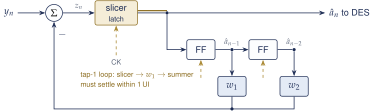
The key step is to put a slicer inside the loop. The fed-back value is then a clean decision \(\hat a_{n-1}\in\{-1,+1\}\), the noise on \(y\) is never recirculated, and the DFE adds no noise. With \(N\) taps (Figure 8.1):
Key equation · \(N\)-tap DFE
\[z_n=y_n-\sum_{k=1}^{N}w_k\,\hat a_{n-k},\qquad \hat a_n=\operatorname{sgn}(z_n),\qquad w_k=A\,p_{k} \tag{8.2}\]
Here \(y_n\) is the summer input in volts and the slicer threshold is 0. The DFE coefficients are the post-cursors: the ideal \(w_k\) is the post-cursor at the DFE input (after TX FFE and CTLE) times \(A\).
Post-cursors only
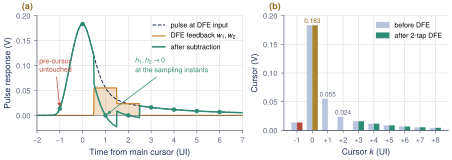
The DFE cancels only the ISI of bits already decided: the pre-cursor of bit \(n+1\) hits \(y_n\) before \(\hat a_{n+1}\) exists. Figure 8.2 shows the feedback staircase on the REF pulse after an 8 dB CTLE. It matches the pulse at \(k=1,2\) and leaves the pre-cursor and the tail untouched.
Error propagation
Instability is a risk for the linear prototype only. With a slicer in the loop the output is bounded, and the real risk is error propagation: a wrong decision adds \(2w_1\) of error to the next sample instead of removing \(w_1\). In the Lab 5 setup (\(w_1=27.6\,\mathrm{mV}\), half-eye 64.7 mV after two taps) that leaves only 9.5 mV of margin on the next bit. At a BER near \(10^{-12}\) first errors are so rare that this at most doubles the BER [22]. Keep \(p_{1}/p_{0}\lesssim0.5\) at the DFE input.
Worked Example 8.1 · A DFE alone, and a DFE with a TX pre-tap
Take the pulse of Worked Example 6.2, \(x_{-1}=0.2\), \(x_0=0.85\), \(x_1=-0.2\), \(x_2=0.1\), \(x_3=0.05\). Forcing the decision sequence \(\hat y=\{\dots,0,1,0,0,\dots\}\) at \(t=T_\mathrm{b},2T_\mathrm{b},3T_\mathrm{b}\) gives \(-\alpha_k+x_k=0\), so the taps are the post-cursors: \(\alpha=[-0.2,\ 0.1,\ 0.05]\). With \(2A=1\) (so \(w_k=x_k/2\) in volts), the PDA eye becomes \(0.85-0.2=0.65\). Only the pre-cursor remains.
Now add a TX pre-tap with \(c_{-1}/c_0=-0.2/0.85\), normalized to \(c=[-0.190,\,0.810]\). By Equation (6.2) the cursors for \(k=-2..3\) become \(-0.038\), 0, 0.726, \(-0.181\), 0.071 and 0.041. The DFE re-adapts to the last three, and the eye is \(0.726-0.038=\mathbf{0.688}\). That beats both the 3-tap ZF FFE alone (0.519, Worked Example 6.2) and the DFE alone (0.65). This is the canonical split: the TX takes the pre-cursor and the DFE takes the post-cursors.
8.2The tap-1 timing loop
Decision \(\hat a_{n-1}\) must be resolved, weighted and subtracted, and the summer settled, before \(z_n\) is sampled one UI later:
Key equation · DFE tap-1 critical path
\[t_\mathrm{CK\to Q}+t_\mathrm{tap}+t_\mathrm{settle}+t_\mathrm{setup}\le T_\mathrm{b}=200\,\mathrm{ps} \tag{8.3}\]
Taps 2 and higher have one or more extra UIs, so tap 1 sets the speed limit.
Half rate
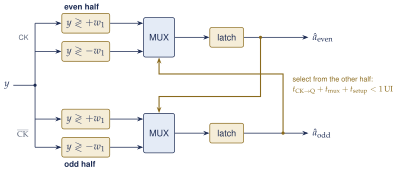
Open-SERDES slices even bits on the rising and odd bits on the falling edge of the 2.5 GHz clock, so each latch has 2 UI to regenerate. Half rate does not relax Equation (8.3): the even decision must correct the odd sample one UI later, so the tap-1 path crosses between the halves and still has 1 UI.
Loop unrolling
Loop unrolling (speculation) removes the summer from the tap-1 path. Two comparators per half precompute both answers, against \(+w_1\) and \(-w_1\), and a multiplexer selected by the previous decision picks one [22]: \[\hat a_n=\begin{cases}\operatorname{sgn}(y_n-w_1), & \hat a_{n-1}=+1\\ \operatorname{sgn}(y_n+w_1), & \hat a_{n-1}=-1\end{cases} \qquad\Rightarrow\qquad t_\mathrm{CK\to Q}+t_\mathrm{mux}+t_\mathrm{setup}\le T_\mathrm{b}. \tag{8.4}\] Figure 8.3 shows the half-rate version. The cost is \(2^N\) comparators for \(N\) unrolled taps, twice the load on the CTLE, and taps that live in comparator thresholds.
Worked Example 8.2 · Tap-1 timing budget at 5 Gb/s
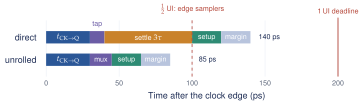
Use illustrative SG13G2 CML numbers, to be confirmed post-layout: latch \(t_\mathrm{CK\to Q}=25\text{–}35\,\mathrm{ps}\); tap switch about 10 ps; summer with \(R_L=250\,\Omega\) and \(C=80\,\mathrm{fF}\), so \(\tau=20\,\mathrm{ps}\) and 95 % settling takes \(3\tau=60\,\mathrm{ps}\); setup and aperture about 20 ps; skew and PVT margin about 20 ps. The total is about 135–145 ps, which is below 200 ps. Direct feedback works at 5 Gb/s, including in the half-rate cross-coupled form, with 55–65 ps to spare (Figure 8.4).
It does not meet the 100 ps half-UI budget that would apply if the \(90^\circ\)/\(270^\circ\) edge samplers also had to see a fully corrected signal. In Open-SERDES the edge samplers therefore see a partly settled correction, which works because TX and CTLE keep the pre-DFE eye open (Section 8.5). If post-layout corners push the direct path past about 0.7 UI, unroll tap 1: with an assumed 15 ps mux the unrolled path is 85 ps. Halving \(C\) (fewer taps) or an integrating summer saves about 30 ps.
8.3Adapting the taps
The ideal taps depend on channel, temperature and supply, so the receiver should find them itself. Define the slicer error \(e_n=z_n-d_\mathrm{lev}\,\hat a_n\), where \(d_\mathrm{lev}\) is the expected signal level (ideally \(Ap_{0}\)). Since \(\partial E[e_n^2]/\partial w_k=-2E[e_n\hat a_{n-k}]\), stepping against the gradient gives the LMS update. Hardware prefers the sign-sign form (SS-LMS), which needs only signs [22, 23]:
Key equation · LMS and sign-sign LMS
\[\begin{gathered} \text{LMS:}\quad w_k\leftarrow w_k+\mu\,e_n\,\hat a_{n-k}\\[2pt] \text{SS-LMS:}\quad w_k\leftarrow w_k+\mu\,\operatorname{sgn}(e_n)\,\hat a_{n-k},\qquad d_\mathrm{lev}\leftarrow d_\mathrm{lev}+\mu\,\operatorname{sgn}(e_n)\,\hat a_n \end{gathered} \tag{8.5}\]
\(\operatorname{sgn}(e_n)\) comes from one extra comparator, the error sampler, with threshold \(\pm d_\mathrm{lev}\) chosen by \(\hat a_n\). The updates are digital counters decimated to the deserialized rate: slow compared with the data, fast compared with temperature drift.
Worked Example 8.3 · Sign-sign LMS on the REF channel
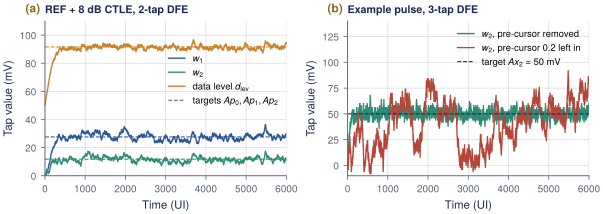
Simulate the Lab 5 setup (REF + 8 dB CTLE) with PRBS13, 4 mV rms noise and a 2-tap DFE adapted by Equation (8.5) with \(\mu=0.25\,\mathrm{mV}\), starting from \(w=0\) and \(d_\mathrm{lev}=50\,\mathrm{mV}\). The pre-DFE eye is open (60 mV), so decisions are correct from the first bit. \(w_1\) comes within 2 mV of \(Ap_{1}=27.6\,\mathrm{mV}\) after about 310 UI and \(w_2\) reaches \(Ap_{2}=11.8\,\mathrm{mV}\) after about 170 UI (Figure 8.5a). Both then dither by a few \(\mu\); after 6000 UI they read 29.8 and 11.5 mV, with \(d_\mathrm{lev}=94.0\,\mathrm{mV}\) (target 91.6). A larger \(\mu\) converges faster but dithers more, and dither is a tap error that costs eye.
An uncancelled pre-cursor makes SS-LMS wander
The 0.2 pre-cursor puts \(\pm Ax_{-1}=\pm100\,\mathrm{mV}\) into every error sample. Once the tap errors are smaller than that, \(\operatorname{sgn}(e_n)\) is set by \(Ax_{-1}\hat a_{n+1}\) alone, which is uncorrelated with \(\hat a_{n-k}\): the average update vanishes and the taps random-walk (Figure 8.5b). Cancel the pre-cursor first (TX pre-tap or CTLE), or use a smaller \(\mu\) and average.
8.4The DFE on the REF channel
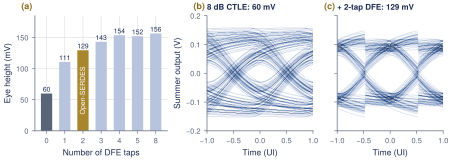
Lab 5 adds DFE taps one at a time after an 8 dB CTLE (Figure 8.6). The taps are the post-cursors at the DFE input, 0.0552, 0.0235 and 0.0160, so \(w_k=27.6\), 11.8 and 8.0 mV. The first tap lifts the PRBS7 eye from 60.0 to 110.7 mV, the second adds 19 and the third 13.5 mV. Beyond four taps nothing more is gained (153.6, 152.1 and 156.4 mV for 4, 5 and 8 taps). At 10 mV rms slicer noise the estimated BER is \(3.2\times10^{-14}\) with three taps and \(4.5\times10^{-12}\) with two.
Lab 5: DFE
lab5_dfe.py reads the taps off the pulse response, runs sdp.Receiver.nrz_DFE with 0–8 taps and estimates the BER. Then try a \(-6\) dB TX preset with 2 taps (Section 16.6).
8.5Splitting the work
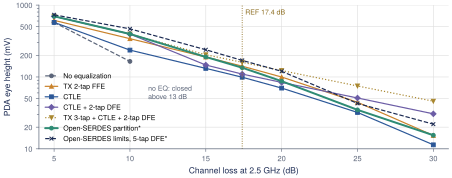
How should Open-SERDES divide the work between TX FFE, CTLE and DFE (Section 5.4)? Table 8.1 and Figure 8.7 compare seven strategies on the link.py channel family.
Method
Channels are channel(LOSS_FAMILY[d]) for 5–30 dB at \(f_\mathrm{N}\), plus REF. The CTLE is ctle(pk), 0–20 dB in 1 dB steps. The TX FFE is a grid search over \(c_{-1}\in[-0.2,0]\) and \(c_1\in[-0.5,0]\) (step 0.02) with \(c_0=1-\lvert c_{-1}\rvert-\lvert c_1\rvert\). The DFE is ideal: it removes the first \(N\) post-cursors exactly. Each strategy is scored by its PDA eye over \(k=-4..40\), maximized over sampling phase and free settings, and also normalized to \(2Ap_{0}\) of the unequalized pulse, which exposes the swing cost of TX equalization. The “Open-SERDES limits” rows add \(\lvert c_1\rvert\le0.25\) (6 dB post-tap de-emphasis), \(\lvert c_{-1}\rvert\le0.1\), CTLE \(\le12\) dB, and an eye open before the DFE (for start-up adaptation and the edge samplers). Because the tail is summed to 40 UI, the unequalized REF eye is \(-0.23\) V rather than the 13-cursor \(-0.161\) V of Table 3.2.
| 10 dB | 15 dB | REF 17.4 dB | 20 dB | 25 dB | ||||||
|---|---|---|---|---|---|---|---|---|---|---|
| 2-3(lr)4-5(lr)6-7(lr)8-9(l)10-11 Strategy | mV | norm | mV | norm | mV | norm | mV | norm | mV | norm |
| No equalization | 165 | 0.30 | closed | closed | closed | closed | ||||
| TX 2-tap FFE | 341 | 0.61 | 189 | 0.48 | 141 | 0.42 | 100 | 0.34 | 44 | 0.20 |
| CTLE (0–20 dB) | 236 | 0.42 | 132 | 0.33 | 99 | 0.29 | 70 | 0.24 | 32 | 0.15 |
| CTLE + 2-tap DFE | 395 | 0.71 | 146 | 0.37 | 110 | 0.32 | 84 | 0.29 | 51 | 0.23 |
| TX 3-tap + CTLE + 2-tap DFE | 396 | 0.71 | 204 | 0.52 | 160 | 0.47 | 123 | 0.42 | 75 | 0.34 |
| Open-SERDES limits, 2-tap DFE\(^\ast\) | 396 | 0.71 | 190 | 0.48 | 134 | 0.40 | 87 | 0.30 | 35 | 0.16 |
| Open-SERDES limits, 5-tap DFE\(^\ast\) | 467 | 0.84 | 239 | 0.60 | 170 | 0.50 | 120 | 0.41 | 43 | 0.19 |
What the numbers say
No single equalizer is enough at REF. The TX FFE alone reaches 141 mV but needs 12 dB of de-emphasis; the CTLE alone needs 16 dB of peaking, outside our range, for 99 mV.
With a DFE present, the noise-free optimum moves the linear work into the TX (CTLE at 0 dB, 11–16 dB of de-emphasis). In a PDA our normalized CTLE and the TX FFE pay the same price, a lower low-frequency level, and the 1-UI FIR fits a sampled channel better. The PDA cannot see noise, crosstalk, sampler sensitivity or adaptivity, which are what limit large de-emphasis in practice.
Within practical limits the REF eye is 134 mV (0.40 of the unequalized main cursor). Three more DFE taps add 36 mV.
Above about 22 dB the 12 dB CTLE limit binds. At 25 dB, CTLE + 2-tap DFE with 19 dB of peaking (51 mV) beats both Open-SERDES rows; more DFE taps help less than more CTLE.
Worked Example 8.4 · The REF operating point in the time domain
Check the partition with the Lab 5 machinery: PRBS7 through REF, a TX preset, ctle(pk) and an ideal 2-tap DFE. The BER is estimated at 10 mV rms slicer noise.
| TX preset, CTLE | pre-DFE eye | + 2-tap DFE | \(p_{1}/p_{0}\) | \(w_1\), \(w_2\) (mV) | BER |
|---|---|---|---|---|---|
| none, 8 dB (Lab 5) | 60.0 | 129.5 | 0.30 | 27.6, 11.8 | \(4.5\times10^{-12}\) |
| none, 0 dB | \(-84.0\) | 167.1 | 0.54 | 91.2, 45.6 | \(1.3\times10^{-15}\) |
| \(-3.5\) dB, 0 dB | 35.4 | 169.5 | 0.37 | 51.1, 23.5 | \(3.5\times10^{-17}\) |
| \(-6\) dB, 0 dB | 96.9 | 171.8 | 0.26 | 31.1, 11.7 | \(3.0\times10^{-18}\) |
| \(-6\) dB, 4 dB | 103.0 | 132.6 | 0.15 | 12.7, 5.9 | \(1.4\times10^{-12}\) |
A DFE alone (row 2) opens the eye, but with a closed pre-DFE eye it cannot adapt from start-up, and \(p_{1}/p_{0}=0.54\) invites error propagation. The \(-6\) dB preset with the CTLE near 0 dB gives the best eye, an open pre-DFE eye (97 mV) for the edge samplers, and \(p_{1}/p_{0}=0.26\): a wrong decision costs \(2w_1=62\,\mathrm{mV}\) of the 86 mV half-eye.
The Open-SERDES partition, and why
TX: 3-tap FFE, mostly de-emphasis (\(-3.5\)/\(-6\) dB presets, pre-tap up to \(\lvert c_{-1}\rvert=0.1\); REF uses \(-6\) dB). It is the only block that removes the pre-cursor without noise, and it lowers the long-run level that would overload the CTLE (Section 7.4). It stays moderate because it cannot adapt without a back-channel and because lost launch swing is lost SNR.
RX: CTLE, 0–12 dB. On REF it sits near 0–4 dB and acts mainly as the front-end gain stage. Its range covers longer channels and board-to-board and temperature variation, keeps the pre-DFE eye open for the CDR, and, unlike the TX presets, adapts at the receiver.
RX: 2-tap half-rate DFE, direct feedback. It removes \(p_{1}\) and \(p_{2}\) without noise, with 55–65 ps of tap-1 slack (Worked Example 8.2). Each extra tap adds summer capacitance and slows tap 1 for about 10 mV more eye.
When we would need more. Beyond about 22 dB of loss, add a second CTLE stage (\(>12\) dB), 3–5 DFE taps or an IIR tail tap, and a larger pre-tap. Unroll tap 1 if post-layout timing exceeds about 0.7 UI.
What this means for your design
The partition follows the pulse anatomy of Figure 5.4: the TX pre-tap takes the pre-cursor, de-emphasis and the CTLE take the long tail and keep the pre-DFE eye open, and the DFE takes \(p_{1}\) and \(p_{2}\) without noise. A noise-free PDA would push all linear work into the TX; noise, crosstalk and adaptation pull some of it back into the receiver. Always report the result in millivolts against the noise budget of Section 4.4.
Exercises
The DFE of Worked Example 8.1 with one tap only: what is the PDA eye? If \(\hat a_{n-1}\) is wrong, how much margin is left on bit \(n\)?
Redo Worked Example 8.2 with 120 fF of summer capacitance (more taps). Does direct feedback still fit? What \(R_L\) restores it, and at what cost in summer gain?
Show that the SS-LMS update \(E[\operatorname{sgn}(e_n)\hat a_{n-1}]\) is zero at \(w_1=Ap_{1}\) if the remaining ISI plus noise is symmetric. Why does this not stop the wandering in Figure 8.5(b)?
From the cursors in Section 8.4 (\(p_{-1}=0.0138\), \(p_{0}=0.1832\), tail to \(p_{8}\)), compute the PDA eye after 0, 1 and 2 DFE taps. Why is it lower than the PRBS7 numbers of Figure 8.6? Then use Table 8.1: at 25 dB, which buys more, three extra taps or a 19 dB CTLE?
Key takeaways
A DFE is an IIR equalizer with a slicer in the loop: it cancels post-cursors without amplifying noise, with taps equal to the post-cursors at its input. It cannot touch pre-cursors, so a TX pre-tap plus a DFE beats either alone (0.688 vs 0.519 and 0.65 in Worked Example 8.1).
Tap 1 must settle within 1 UI even at half rate. At 5 Gb/s direct feedback fits in about 140 ps. Unrolling is the fallback if it does not.
SS-LMS adapts taps with one error sampler and counters. It wanders if a large pre-cursor is left uncancelled.
On REF + 8 dB CTLE, DFE taps give \(60\to111\to130\to143\) mV for 0–3 taps. Beyond four taps the gain is negligible.
The Open-SERDES partition is a TX 3-tap FFE (\(-6\) dB on REF), a CTLE with 0–12 dB and a 2-tap half-rate DFE. On REF it gives 172 mV (PRBS7) and 134 mV (PDA).
Beyond about 22 dB of loss, more CTLE peaking and more DFE taps become necessary.
Generated from book/tutorial/chapters/08_dfe.tex. Figure, table and equation numbers match the PDF edition.