
Now recruiting Call for Applications — undergraduate researchers in ECE/EEE & BME · apply by 30 Nov 2026 Call for Applications · by 30 Nov Read the call →Read →
Where biomedical engineering meets IC design innovation

Biomedical Research in Integrated Circuit Design

BRICD is a research community of university undergraduates and academics finding ways to apply biomedical integrated circuit design to solve healthcare problems in the local community — built openly, on open-source PDKs and EDA flows.

7
research projects
5
tape-outs
130nm
open PDKs
100%
open-source flow
// electrode → bits
electrode · ~1 mV

About BRICD

An open community designing the silicon behind better healthcare.

We believe high-performance medical electronics shouldn't be locked behind proprietary tools. BRICD brings undergraduates and academics together to design biomedical integrated circuits entirely in the open.

From low-power data converters to RF transceivers and bio-sensing front-ends, our members take chips from concept through schematic, layout, verification and tape-out — using fully open-source PDKs and EDA flows so every result is reproducible.

Our work spans the Skywater 130nm and IHP SG13G2 BiCMOS processes, and includes the first RF integrated-circuit design paper from the Department of Electronic & Telecommunication Engineering, University of Moratuwa.

See what we're building →

Analog & Mixed-Signal

Data converters, references and low-power interfaces.

RF & Wireless

LC-VCOs, PLLs and transceiver blocks for 2.4 GHz radios.

Biomedical Sensing

Bio-impedance, ear-EEG and motion-artifact front-ends.

Open-Source Silicon

Xschem, Ngspice, OpenEMS, KLayout & OpenROAD.

Research Projects

Chips designed, simulated and taped out in the open.

Each project is a complete open-source design — schematics, layout, SPICE decks and verification all public.

PROJECT 01

A Forward and Inverse Design Approach for Automated Analog Design Optimization and Layout using LLM Agent-based Analytical Modelling (Ongoing)

An ongoing open-source framework that automates analog circuit sizing and layout in open PDKs, where silicon area on multi-project shuttles is a premium resource. It began as a hybrid mixed-variable particle-swarm optimizer built on the gm/ID methodology to minimize layout area while meeting design specifications — demonstrated on a low-power instrumentation amplifier in 130 nm CMOS with a 90.33% gate-area reduction over existing implementations — and is being extended with LLM agent-based analytical modelling for both forward and inverse design.

LLM Agents gm/ID Mixed-Variable PSO Analog Layout 130nm CMOS Ongoing
90.33%
gate-area reduction
INA
low-power demo
Fwd + Inv
design modes
130nm
open PDK
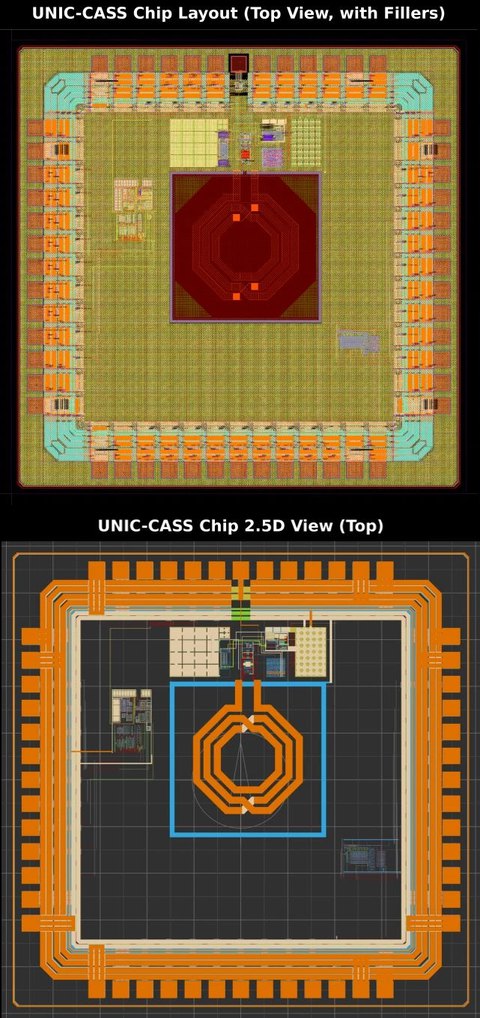
UNIC-CASS chip layout with the 2.4 GHz PLL: top view with fillers and 2.5D top view
PROJECT 02

A 2.4 GHz LC-VCO Fractional-N Phase-Locked Loop in 130 nm BiCMOS

A type-II Δ-Σ fractional-N PLL with a cross-coupled differential LC-VCO and a custom spiral inductor (4 nH, Q = 16.8) modelled in OpenEMS — the first fully open-source RF IC design of its kind from Sri Lanka, demonstrating that high-performance radios are achievable in the open CMOS ecosystem. Published at SMACD 2026 and submitted for fabrication through the UNIC-CASS 2025 program with full DRC, LVS and PEX sign-off.

IHP SG13G2 130nm Fractional-N PLL Δ-Σ Modulation OpenEMS UNIC-CASS 2025 SMACD 2026
2.45 GHz
center freq
−100.8
dBc/Hz @ 1MHz
12.73 mW
DC power
0.347 mm²
chip area
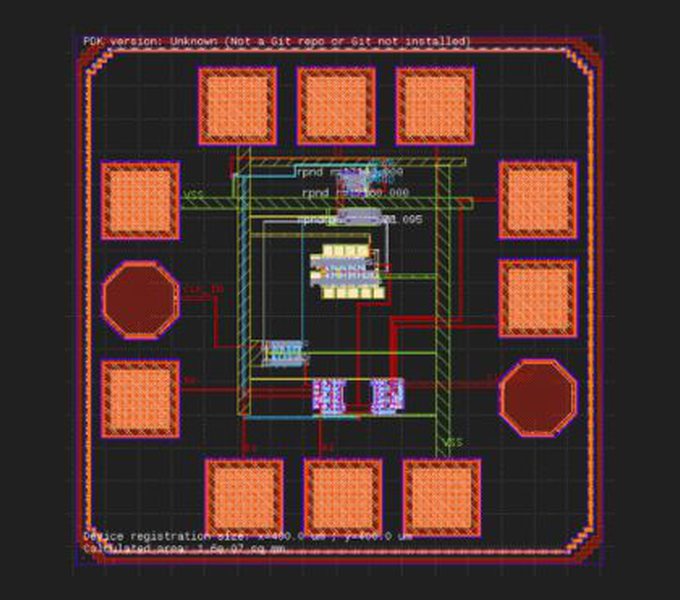
Layout of the EpitaXC fully-differential op-amp tile on Tiny Tapeout SKY25a
PROJECT 03

Dry-Contact Ear-EEG with Continuous Electrode-Skin Impedance Monitoring — Moving On Chip

A dry-contact Ear-EEG system that injects a 1 kHz driven-right-leg stimulus to continuously track electrode-skin impedance mismatch, using it as the reference for online adaptive motion-artifact cancellation (IEEE BioCAS 2026). The team — Lohan Atapattu, Sajitha Madugalle, Imasha Nethmal and Erandee Jayathilaka — is now integrating the I/Q impedance-extraction path in CMOS: a fully-differential two-stage op-amp on Tiny Tapeout SKY25a (silicon received July 2026) and fully-differential I/Q multipliers in IHP SG13G2 for UNIC-CASS 2025, presented in a paper submitted to IEEE ICM 2026.

SkyWater 130nm Tiny Tapeout SKY25a Ear-EEG IHP SG13G2 I/Q Demodulation UNIC-CASS 2025 BioCAS 2026 ICM 2026 · Submitted
12.6 dB
artifact reduction
1 kHz
DRL stimulus
1.8 V
op-amp supply
130nm
SkyWater PDK
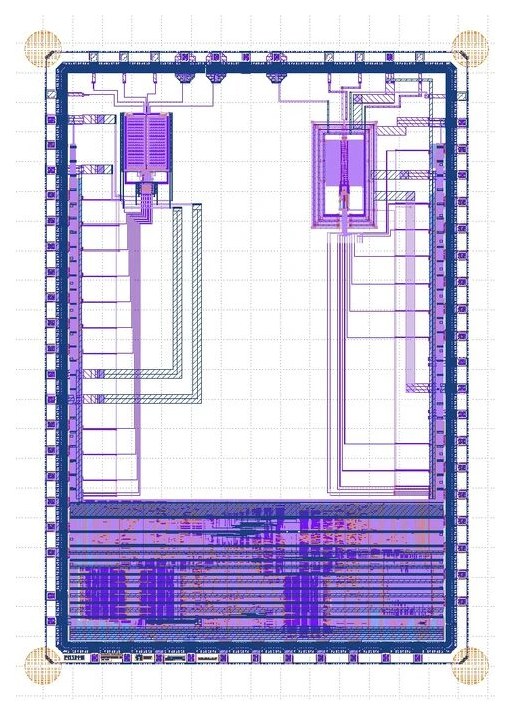
Layout of the 30 MHz fractional-N PLL on IHP SG13G2
PROJECT 04

A 30 MHz Charge-Pump Fractional-N PLL — Our First IHP BiCMOS Tape-out

A charge-pump type-II PLL that synthesizes programmable output frequencies from a 10 MHz reference, using an 11-stage ring VCO and two 3-bit programmable dividers (fout = M/N × fref). Designed over five months with Xschem, Ngspice, KLayout and KPEX, and submitted to the July 2025 IHP OpenMPW shuttle — the team's first tape-out in the IHP 130 nm BiCMOS open PDK.

IHP SG13G2 130nm Charge-Pump PLL Ring VCO KPEX IHP OpenMPW 2025
10 MHz
reference
1.4–30
MHz output
3-bit
M / N dividers
130nm
IHP SG13G2
Full-chip layout of the SAR ADC on the Efabless chipIgnite (Caravel) harness
PROJECT 05

A 100 kSPS 8-bit Fully-Differential SAR ADC for Low-Power Applications

A charge-redistribution SAR ADC with binary-weighted capacitor arrays, an auto-zeroed pre-amplifier and regenerative latch comparator, and digital SAR logic — aimed at battery- or RF-powered IoT and wearable/implantable medical devices. Built from scratch by ENTC undergraduates in ten weeks with Xschem, Ngspice, Netgen, OpenLane, Magic and KLayout, and submitted to the Efabless chipIgnite shuttle through the IEEE CASS UNIC-CASS 2024 program — ENTC's first CMOS tape-out.

SkyWater 130nm Charge-Redistribution SAR Fully-Differential chipIgnite UNIC-CASS 2024
8-bit
resolution
100 kSPS
sample rate
7.5 bit
target ENOB
1.8 V
AVDD / DVDD
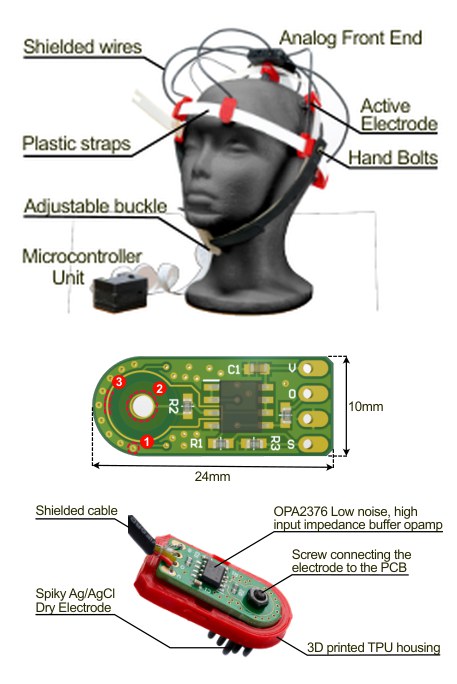
BraiNeoCare adjustable EEG headset with active dry-contact electrodes, and the active electrode PCB in its 3D-printed housing
PROJECT 06

BraiNeoCare: Low-Cost Dry-Contact EEG and Explainable AI for Neonatal Seizure Detection & Prediction

A research line toward affordable seizure care for newborns, where continuous video-EEG is costly and needs specialists. It combines an adjustable 3D-printed headset with active dry-contact electrodes and a custom analog front end, a multimodal artifact-removal algorithm, and explainable deep-learning models that work from a reduced EEG montage — detecting seizures in real time and, with added ECG, predicting them up to 30 minutes before onset. Clinically evaluated against a commercial wet-electrode cEEG system at Lady Ridgeway Hospital for Children, with work published in IEEE TBME and IEEE SMC and accepted at IEEE BHI 2026 (Hong Kong, December 2026).

Dry-Contact EEG Active Electrodes Explainable AI Neonatal Seizures IEEE TBME SMC 2024 BHI 2026
> 0.8
corr. vs clinical cEEG
97.5%
prediction accuracy
30 min
warning before onset
+16.3%
detection recall
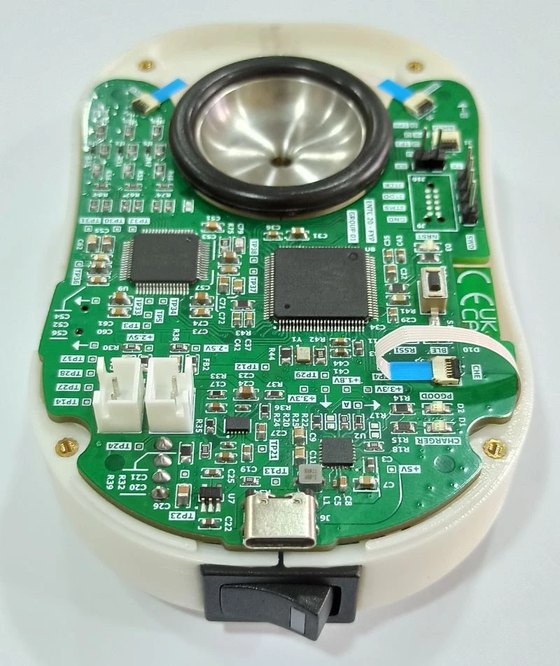
Intelliscope ECG-PCG device: PCB with stethoscope diaphragm in its 3D-printed enclosure
PROJECT 07

Intelliscope: A Simultaneous ECG-PCG Screening Tool for Cardiovascular Disease in Resource-Constrained Settings

An end-to-end dual-modality device that records electrocardiogram and phonocardiogram signals together, with a real-time burst-adaptive NLMS noise-cancellation pipeline light enough for embedded hardware. Validated on real recordings from noisy hospital wards, it improved SNR by 30.32 dB (ECG) and 37.01 dB (PCG). Presented at IEEE EMBC 2026 in Toronto and winner of the 2025 SLAAS Manamperi Main Award for the best inter-university final-year engineering project in Sri Lanka. The project began in 2020 as a low-cost AI-powered wireless stethoscope that won first runner-up in the IEEE CASS COVID-19 Special Student Design Competition at ISCAS 2020, followed by a transfer-learning ECG-PCG screening paper at ISCAS 2021.

ECG + PCG Adaptive Noise Cancellation Embedded Manamperi Award 2025 ISCAS 2021 EMBC 2026
30.3 dB
ECG SNR gain
37.0 dB
PCG SNR gain
2
modalities
Real-time
on-device
Publications

Peer-reviewed & open work.

IEEE BioCAS
2026

A Dry-Contact Ear-EEG System With Continuous Electrode-Skin Impedance Mismatch Monitoring for Motion Artifact Cancellation Using DRL Stimulus

L. Atapattu, S. Madugalle, I. Nethmal, E. Jayathilaka, A. Herath, K. Wickremasinghe, S. L. Kappel, N. Udayanga, C. U. S. Edussooriya · IEEE Biomedical Circuits and Systems Conference

Accepted · Incheon, KR
IEEE ICM
2026

An Open-Source CMOS ASIC for I/Q Based Electrode-Skin Impedance Mismatch Extraction

I. Nethmal, L. Atapattu, E. Jayathilaka, S. Madugalle, A. Herath, K. Wickremasinghe, S. L. Kappel, N. Udayanga, C. U. S. Edussooriya · IEEE International Conference on Microelectronics · Key blocks submitted for fabrication in SkyWater 130 nm and IHP SG13G2

Submitted
IEEE EMBC
2026

A Simultaneous ECG-PCG Acquisition System with Real-Time Burst-Adaptive Noise Cancellation

A. Herath, M. Jayalath, K. Kaushalya, S. Kapukotuwa, C. Wijegunawardena, P. Mendis, K. Wickremasinghe, D. Samarasinghe, W. N. Manamperi, C. U. S. Edussooriya · 48th Annual International Conference of the IEEE Engineering in Medicine & Biology Society

Presented · Toronto, CA
IEEE BHI
2026

A Patient-Independent Neonatal Seizure Prediction Model Using Reduced Montage EEG and ECG

S. Ranasingha, A. Haputhanthri, H. Marasinghe, N. Wickramasinghe, K. Wickremasinghe, J. Wanigasinghe, C. U. S. Edussooriya, J. P. Kulasingham · IEEE International Conference on Biomedical and Health Informatics

Accepted · Hong Kong, CN
SMACD
2026

A 2.4 GHz LC-VCO Fractional-N Phase-Locked Loop Open-Source Design in 130 nm BiCMOS

M. Thiriloganathan, S. Ranasinghe, A. Herath, R. Rameshkumar, H. Marasinghe, A. Viduranga · Supervised by K. Wickremasinghe & G. Leelarathne · Intl. Conf. on Synthesis, Modeling, Analysis & Simulation Methods and Applications to Circuit Design

Published · Dresden, DE
arXiv
2026

A Forward and Inverse Design Approach for Automated Analog Design Optimization and Layout using LLM Agent-based Analytical Modelling

A. Herath, C. Luckshan, L. Katugaha, U. Mendis, K. Wickremasinghe · Preprint (earlier version: “Area Optimization of Open-Source Low-Power INA in 130nm CMOS using Hybrid Mixed-Variable PSO”)

Preprint
UNIC-CASS
2025

A 2.4 GHz Type-II Δ-Σ Fractional-N PLL with Cross-Coupled LC-VCO and Custom 4 nH Inductor in IHP SG13G2

M. Thiriloganathan, A. Herath, S. Ranasinghe, R. Rameshkumar, H. Marasinghe, A. Viduranga, G. Leelarathne · PI: K. Wickremasinghe · IEEE CASS UNIC-CASS 2025 program, IHP SG13G2 130 nm BiCMOS

Tape-out
UNIC-CASS
2025

Fully-Differential I/Q Multipliers for Electrode-Skin Impedance Extraction in IHP SG13G2

L. Atapattu, I. Nethmal, S. Madugalle, E. Jayathilaka · IEEE CASS UNIC-CASS 2025 program, IHP SG13G2 130 nm BiCMOS · Building block of the I/Q impedance-extraction ASIC (submitted to IEEE ICM 2026)

Tape-out
IEEE TBME
2025

An Active Dry-Contact Continuous EEG Monitoring System for Seizure Detection Applications in Clinical Neurophysiology

N. L. Wickramasinghe, D. S. Udayantha, A. Abeyratne, K. Weerasinghe, K. Wickremasinghe, J. Wanigasinghe, A. De Silva, C. U. S. Edussooriya · IEEE Transactions on Biomedical Engineering

Published · Journal
Tiny Tapeout
2025

EpitaXC — A Fully-Differential Two-Stage Operational Amplifier in SkyWater 130 nm

L. Atapattu, S. Madugalle, I. Nethmal, E. Jayathilaka · Tiny Tapeout SKY25a shuttle

Silicon received
IHP OpenMPW
2025

A 30 MHz Charge-Pump Fractional-N PLL in IHP SG13G2 130 nm BiCMOS

A. Herath, H. Marasinghe, M. Thiriloganathan, N. Methsarani, U. Dilhara, Y. Amarasinghe, N. Kavinda · Mentored by K. Wickremasinghe · July 2025 IHP OpenMPW shuttle

Tape-out
IEEE SMC
2024

Using Explainable AI for EEG-based Reduced Montage Neonatal Seizure Detection

D. S. Udayantha, K. Weerasinghe, N. Wickramasinghe, A. Abeyratne, K. Wickremasinghe, J. Wanigasinghe, A. De Silva, C. U. S. Edussooriya · IEEE International Conference on Systems, Man, and Cybernetics

Published · Sarawak, MY
UNIC-CASS
2024

A 100 kSPS 8-bit Fully-Differential SAR ADC for Low-Power Applications in 130 nm SkyWater PDK

L. Atapattu, S. Madugalle, H. Maduwantha, I. Nethmal, E. Jayathilaka · Mentored by U. Mendis, K. Wickremasinghe & N. Udayanga · Efabless chipIgnite shuttle via IEEE CASS UNIC-CASS

Tape-out
IEEE ISCAS
2021

A Novel Transfer Learning-Based Approach for Screening Pre-existing Heart Diseases Using Synchronized ECG Signals and Heart Sounds

R. Hettiarachchi, U. Haputhanthri, K. Herath, H. Kariyawasam, S. Munasinghe, K. Wickremasinghe, D. Samarasinghe, A. De Silva, C. U. S. Edussooriya · IEEE International Symposium on Circuits and Systems

Published · Daegu, KR
Team & Members

The people behind the silicon.

A growing community of undergraduates and academics.

Kithmin Wickremasinghe

Kithmin Wickremasinghe

FOUNDER · ADVISOR (MASc)

Leads and supervises BRICD's research efforts, mentoring undergraduates through the full open-source IC design flow — from architecture to tape-out.

Avishka Herath

Avishka Herath

RESEARCHER · ANALOG / MIXED-SIGNAL

Core contributor to BRICD's analog and mixed-signal work, including the 2.4 GHz fractional-N PLL published at SMACD 2026, and mentor for recent IC design projects.

Udara Mendis

Udara Mendis

RESEARCHER · ADVISOR (MSc)

Advises BRICD's digital and mixed-signal IC design work, with a background in digital ASIC design.

Research Mentors

Researchers & Contributors

News

Latest from the group.

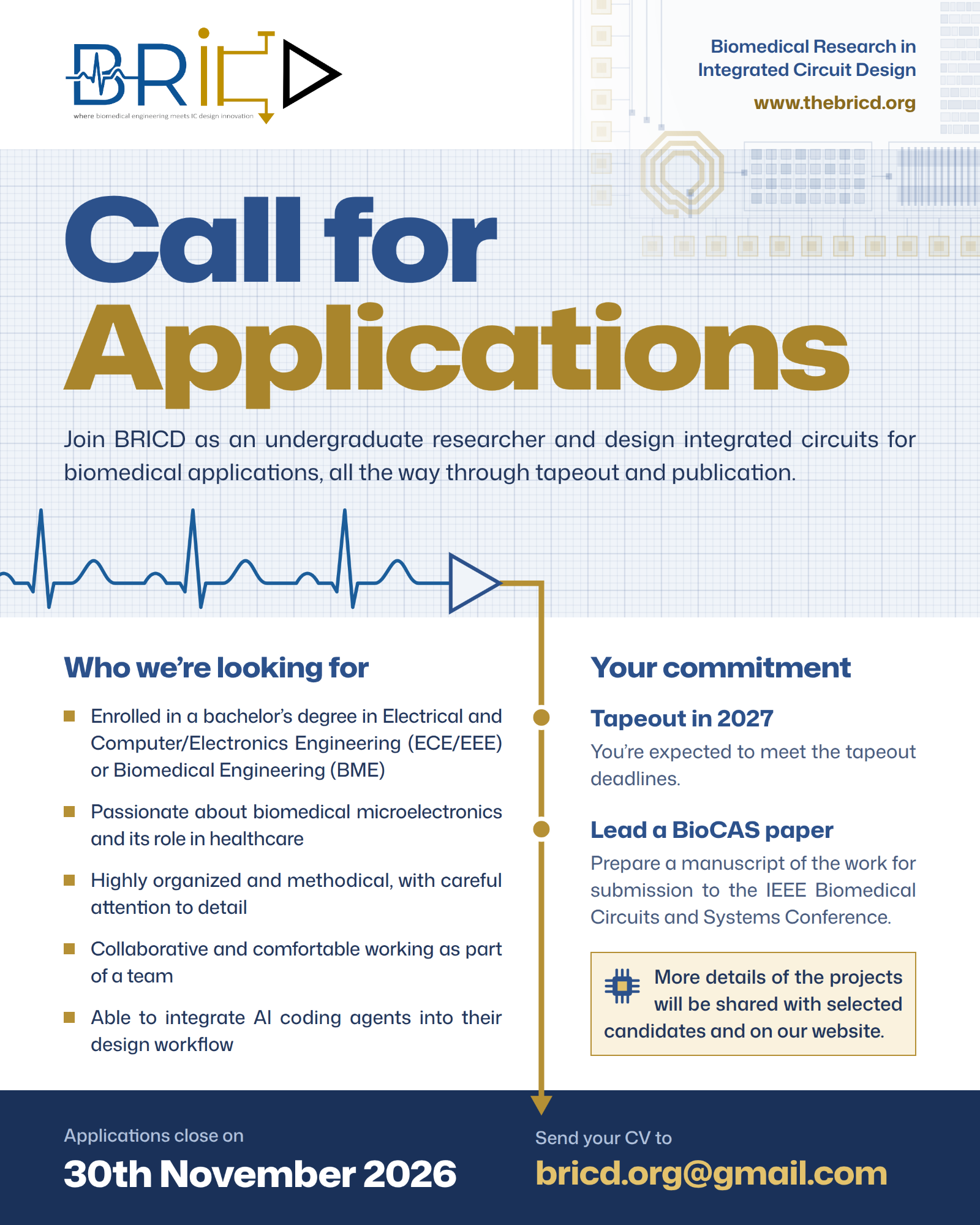
Call for Applications · closes 30 Nov 2026

Design biomedical ICs with us — from schematic to silicon to paper.

Join BRICD as an undergraduate researcher and design integrated circuits for biomedical applications, all the way through tapeout and publication.

Who we’re looking for

  • Enrolled in a bachelor’s degree in Electrical and Computer/Electronics Engineering (ECE/EEE) or Biomedical Engineering (BME)
  • Passionate about biomedical microelectronics and its role in healthcare
  • Highly organized and methodical, with careful attention to detail
  • Collaborative and comfortable working as part of a team
  • Able to integrate AI coding agents into their design workflow

Your commitment

Tapeout in 2027
You’re expected to meet the tapeout deadlines.
Lead a BioCAS paper
Prepare a manuscript of the work for submission to the IEEE Biomedical Circuits and Systems Conference.

More details of the projects will be shared with selected candidates and on our website.

Applications close 30 November 2026 · send your CV to bricd.org@gmail.com

BRICD Call for Applications flier: undergraduate researchers in ECE/EEE or BME; tapeout in 2027 and lead a BioCAS paper; applications close 30 November 2026; send your CV to bricd.org@gmail.com Click to open the full flier
Join Us

Want to design chips with us?

We welcome undergraduates, researchers and collaborators interested in open-source biomedical IC design. Reach out — tell us what you'd like to build.